What Is Google AI Max? Why It Matters and What To Do Today
21 May 2026
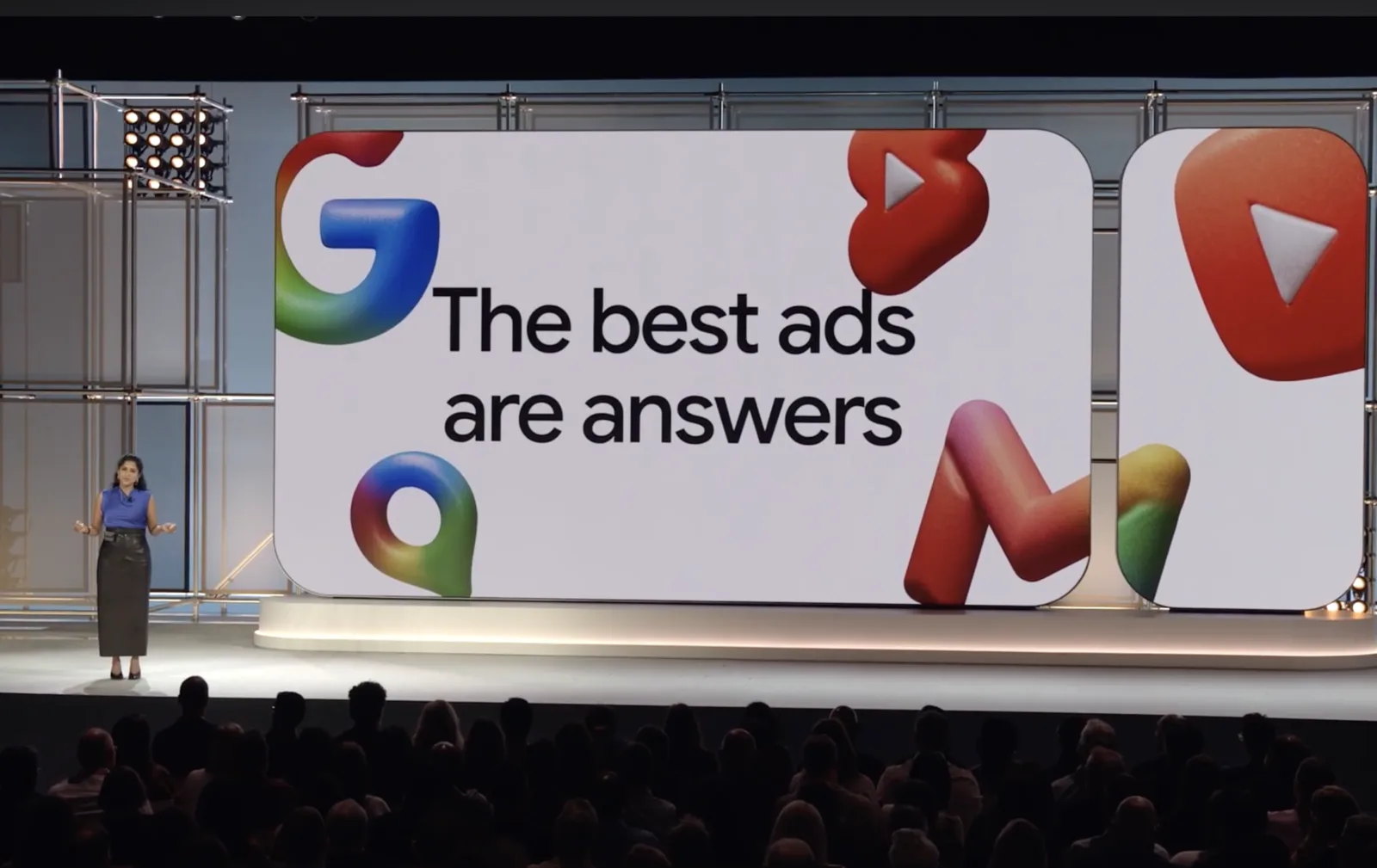
On 19 May 2026 at I/O, Google said the search box is being rebuilt for AI — its biggest change in 25 years. AI Max is the paid-Search half of that shift, out of beta and globally available since April 2026.
It isn't a new campaign type. It's a set of toggles inside existing Search campaigns. The toggles let Google match broader queries, rewrite headlines from your pages, and pick which URL the click lands on. It's also the gate to the new AI Mode ad formats. The new lever isn't the bid — it's the quality of your inputs.
Why search behaviour is shifting from keywords to situations
For 25 years, the search box trained us to think like machines. We compressed full thoughts into three-word queries — "best dentist near me," "CRM software Singapore," "performance marketing agency" — because that's what the box rewarded.
The whole of paid Search was built on that compression. A keyword revealed intent. You bought the keyword, wrote an ad that mirrored it, sent the click to a page about it. Done.
Google's 19 May 2026 I/O announcement (Liz Reid, VP Search) ends that assumption. The new intelligent Search box "dynamically expands to give you space to describe exactly what you need" and accepts text, images, files, videos, and Chrome tabs as inputs. AI Overviews and AI Mode now flow together as one experience — question, response, follow-up — with AI Mode having passed one billion monthly users and AI Overviews at 2.5 billion.
When users can describe the full situation, the query stops being a keyword and becomes context.
A parent doesn't search "international school Singapore" anymore. They ask: "My child is struggling in the local system and I don't know whether IB or British curriculum suits them better. What should I consider?"
A clinic prospect doesn't search "pigmentation treatment." They ask: "Why did I start getting dark patches after pregnancy and what treatments are safe while breastfeeding?"
A B2B buyer doesn't search "payment gateway Asia." They ask: "We're a US ecommerce brand expanding into SEA and need to accept local wallets without hurting checkout conversion. Who should we consider?"
That's the shift. Search is moving from keywords to situations. AI Max is Google Ads moving in the same direction.
What is AI Max for Search campaigns?
Google calls AI Max for Search campaigns an optimisation layer that runs inside existing Search campaigns. Not a new campaign type. A set of toggles that use Google's AI to expand reach, customise creatives, choose landing pages, and add new controls and reporting. It went out of beta and globally available on 15 April 2026 across Google Ads, Editor, Search Ads 360, and the Ads API.
In the same April 2026 post, Google said Dynamic Search Ads, automatically created assets, and campaign-level broad match settings will start auto-upgrading to AI Max from September 2026. Google's framing: "AI Max is the next generation of Dynamic Search Ads." The toggle becomes the default. You can shape it now, or inherit whatever it does later.
The traditional Search flow was simple:
User searches → keyword matches → ad appears → user lands on the URL you set
The AI Max flow has more moving parts:
User expresses a situation → Google interprets intent → Google reads your keywords, ads, assets, and URLs → Google may rewrite the ad → Google may choose a different page on your site → conversion data trains the system
The implication is the part most advertisers underrate. AI Max doesn't just widen keyword coverage. It widens the role of your entire digital footprint inside Google Ads. Your keywords still matter. So do your landing pages, page titles, service pages, ad assets, conversion signals, exclusions, brand rules, and site structure. AI Max is not a media-buying setting. It's a business architecture problem.
| Classic Search | AI Max Search |
|---|---|
| Keyword-led | Intent-led |
| Match types control eligibility | Google AI interprets broader signals |
| Advertiser writes fixed ad assets | Google can customise text assets |
| Final URL is fixed | Final URL expansion can pick the page |
| Landing page is post-click only | Landing page is also a matching signal |
| Optimisation focuses on search terms | Optimisation reviews query + headline + URL + outcome |
| Structure built around keywords | Structure built around intent clusters and page sets |
The three features inside AI Max
AI Max has three main capabilities. Each one shifts a different part of the Search flow.
Search term matching changes when you appear. Text customisation changes what Google can say. Final URL expansion changes where the click lands. That's why AI Max isn't a single toggle. Each capability gives Google more influence over a different part of the user journey.
1. Search term matching — from keywords to interpreted intent
Google says AI Max search term matching uses broad match and keywordless technology to find relevant searches outside your existing keywords. It learns from your current keywords, creatives, and URLs.
The key part is that last one. AI Max doesn't only ask "does this query match a keyword?" It also asks: does this query relate to the advertiser's landing page? To their ad copy? To the business described on the website? Does the situation look commercially relevant given the signals available?
Search campaigns are moving from pure keyword matching to business interpretation. For sophisticated advertisers that's both exciting and uncomfortable. Exciting because it can find long, messy, high-value queries that no keyword list would predict. Uncomfortable because the precision you used to control isn't yours alone anymore. If your signals are messy, the matches will be too.
The answer isn't "trust Google." The answer is: make your business easier for Google to understand.
2. Text customisation — your website becomes ad source material
AI Max can generate new headlines and descriptions from your landing pages, ads, and keywords. The consequence is straightforward: your website copy now influences your ad copy.
Landing pages used to have one job — persuade the user after the click. In an AI Max environment they have a second job: help Google understand the business accurately. A page that does both well makes the following obvious in the first screen:
- Who it's for
- What problem it solves
- What situations it's relevant to
- What's being offered
- What geography it serves
- What claims are safe to make
- What proof supports those claims
- What the user should do next
Vague page, vague input. Overstuffed page, noisy input. Risky claims, risky inherited language. Clear page, strong source material. The brands that win in AI Max won't have more keywords. They'll have clearer pages.
3. Final URL expansion — Google can choose the page
Final URL expansion lets Google send the click to any page on your domain it thinks matches better than the URL you set. It requires text customisation to be on, so the ad copy can match the page Google picks.
This is the riskiest part. In the classic Search model, advertisers obsessed over message match — keyword to ad to page, all lined up. That's the whole logic behind Single Purpose Campaigns. With Final URL expansion on, Google can decide a different page on your site is a better fit. Your website becomes a pool of possible landing pages.
Clean, structured, commercially useful pool: AI Max routes intelligently. Messy, outdated, weak pool: AI Max creates poor journeys.
The question isn't should we let Google choose the landing page? The better question is which pages are we comfortable letting Google choose from? That's the new control layer.
One operational landmine to flag.
When Final URL expansion is on, pinned RSA assets aren't always respected. If Google picks a different URL, a pinned headline or description that doesn't match the new page can be dropped.
Anyone relying on pinning to surface compliance copy — medical disclaimers, financial risk language, education accreditations — needs to switch to text disclaimers instead.
Pinning was the old workaround. Text disclaimers are the answer.
| AI Max feature | What Google gets more freedom over | What you have to control |
|---|---|---|
| Search term matching | Which queries can trigger ads | Intent clusters, negatives, brand rules |
| Text customisation | Which headlines and descriptions appear | Page copy, text restrictions, claim governance |
| Final URL expansion | Which page the user lands on | URL inclusions, exclusions, page feeds |
| Smart Bidding | Which users are worth more | Conversion quality, offline data, value rules |
| Reporting | How journeys are diagnosed | Query + headline + URL + qualified outcome review |
AI Brief — the new conversational control layer
On 30 April 2026 Google added AI Brief, the most important new control on top of the toggles above.
You write — in plain language — a brief that covers three areas:
- Messaging — brand voice, words and claims to use or avoid.
- Matching — topics to target or exclude.
- Audience guidelines — who you want to reach and who you don't.
Gemini reads the brief and shapes how AI Max picks queries, writes copy, and chooses pages.
It's the closest thing yet to giving Google a creative brief instead of a keyword list. Rolling out in English for AI Max for Search over the coming months.
Why AI Max unlocks the new AI Mode ad formats
This is the part of the story most "what is AI Max" explainers miss. Google is rolling out a new generation of ad formats built for AI Mode, and all of them are exclusive to AI Max or Performance Max campaigns. If you're on classic Search only, you can't run them.
Native ads in AI Mode
An ad that reads like an answer. Generated from your assets and brand guidelines, placed inside the AI Mode conversation, labelled as Sponsored.

Direct Offers in AI Mode
Discounts, local coupons, bundle deals dynamically composed by Gemini from products you supply and rules you set. Retail first, hotel coming.

AI-powered Shopping ads
Standard shopping carousel plus a Gemini-written explainer at the top, picking out the product features that match the user's situation.

Business Agent for Leads
An agent inside your ad. The user can chat — answers drawn from your website — and the lead form arrives pre-filled. Early testing in Education, Automotive, and Real Estate.

The shift is bigger than a new ad type. Google is asking the question — your ad is the answer.
To play in this space, your landing pages, brand voice files, product feeds, and offer rules all have to be in shape. That's the source material Gemini uses to write the ad.
What inputs does AI Max learn from?
If AI Max is the system that interprets queries, writes copy, picks pages, and bids, then the question becomes: what is it interpreting from? Eight categories of input. Every one of them is a choice you can shape — or leave to default. Default is almost never the right answer.
The hub is what people call "AI Max." The spokes are what actually decide whether it works.
This is why "What is AI Max?" has a longer answer than "a Search toggle." It's the system that reads all of these inputs together to decide where, when, and how your business shows up. Shape the inputs — you shape the outcome.
Why AI Max matters now — the September 2026 migration
AI Max isn't an isolated product update. It's the paid-Search half of Google's broader move — from Search as a keyword engine to Search as an AI assistant. On the consumer side: AI Mode, AI Overviews, agents, multimodal input, the intelligent Search box. On the advertiser side: AI Max brings the same logic into Search campaigns — and locks the new ad formats behind it.
Two numbers Google publishes about AI Max.
The big one, on Think with Google: +27% conversions or conversion value at similar CPA/ROAS, AI Max full suite vs campaigns mostly using exact and phrase match keywords.
The quieter one, in the April 2026 DSA upgrade post: +7% when you turn on the full suite (search term matching + text customisation + Final URL expansion) vs search term matching alone.
Both numbers are real. They answer different questions — "should I adopt AI Max?" vs "should I turn on every toggle?" — and both are directional, not promises. The variance underneath them is your account structure, page quality, and conversion signals. Which is precisely why the upstream work matters.
It's not optional forever either. AI Max is becoming part of the Search operating system. Advertisers who treat it as a toggle will lose control. Advertisers who treat it as a signal architecture will gain ground.
How Single Purpose Campaigns evolve in the AI Max era
At Kaliber, we've long believed in Single Purpose Campaigns — campaigns where the keyword, ad, landing page, and conversion intent are tightly aligned. That thinking is still right. The expression of it has to change.
The old SPC was designed for a world where the search term was the cleanest expression of intent. Someone searched "best performance marketing agency Singapore" — you built a campaign on that phrase, wrote an ad on that phrase, sent the click to a page on that phrase.
The new environment doesn't work that way. Today a user might search:
"We're spending $50K a month on Meta and Google but leads are getting worse. Is this an agency problem, landing page problem, or tracking problem?"
That's not a keyword. That's a situation. You can't build a campaign around every possible phrasing of it. You can build a campaign around the commercially meaningful situation it represents.
So the new unit of alignment moves from search term to intent cluster. The same discipline, one level higher. Campaigns still have a job — but the job is now things like:
- Capture high-intent category demand
- Capture location-led demand
- Capture competitor comparison demand
- Capture problem-aware demand
- Capture users evaluating risk
- Capture users ready to book
- Capture users looking for alternatives
That's how you keep strategic control without fighting the direction Google is heading.
How to structure Google Ads campaigns with AI Max
The worst response to AI Max is to dump everything into one campaign and let Google figure it out. That's not sophistication. That's surrender.
The better response is to consolidate where Google needs more signal density, and keep boundaries where the business logic is different.
Split campaigns when the business needs different budget, bidding, conversion goals, URL pools, compliance rules, geography, or reporting.
Brand stays separate because brand demand behaves differently. Competitor stays separate because the copy, legal risk, and page strategy are different. Problem-led discovery isn't judged on the same CPA as bottom-funnel "book now."
Less fragmented by keyword syntax. More deliberate by intent.
| Campaign layer | Purpose | AI Max approach |
|---|---|---|
| Brand | Protect and capture existing demand | Off, or tightly restricted |
| Generic high intent | Capture category demand | Test AI Max with strong URL controls |
| Service / product category | Match users to specific offers | Intent-led ad groups and page sets |
| Problem-led demand | Catch users before the obvious category search | Situation pages and controlled expansion |
| Location-led demand | Match geographic intent | Location pages and local proof |
| Competitor / alternative | Capture comparison behaviour | Strict messaging and legal controls |
| Retargeting / warm | Re-engage known users | Case-by-case by journey stage |
This gives Google room to learn. It doesn't give Google permission to blur every intent together. That's the balance.
How AI Max changes landing page strategy
This may be the biggest mindset shift. Landing pages used to have one job: convert the click. The media team drove traffic, the LP team improved conversion, the SEO team made content, the brand team owned messaging. Four silos.
Under AI Max, the landing page now has three jobs:
- Match signal. AI Max reads your pages to decide which queries you're relevant for. Vague page = vague Google understanding.
- Ad-copy source. Text customisation generates headlines and descriptions from your page content. Weak copy upstream means weak ad copy downstream.
- Agent knowledge base. With Business Agent for Leads, a user can chat inside the ad — and the agent's answers are drawn from your website. The page now has to be answer-ready, not just persuasion-ready.
A weak page doesn't just hurt conversion rate. It hurts traffic quality, ad-copy quality, and how an agent represents your business in conversation before a human gets involved. A messy blog doesn't sit quietly anymore — it joins the signal pool unless you exclude it.
Before turning Final URL expansion on, classify every major URL. Some pages are eligible. Some are excluded. Some need improvement before being used. Some should only run in specific ad groups. Some should never see paid traffic.
performance-marketing
seo-ai-search
singapore
marketing-funnel
category-entry-points
in-house-vs-agency
kaliber-vs-others
black-friday
old-bio
2024-jd
readability
In AI Max, your website isn't just the destination. It's part of the signal system. Media, SEO, content, CRO, and analytics teams have to talk to each other now. AI Max makes that unavoidable.
How to prepare your account for AI Max
The first step isn't turning AI Max on. The first step is getting ready for it.
Review your account through the lens of intent, not keywords. Which campaigns serve the same business purpose and are fragmented only because of historical match-type logic? Which need to stay separate because the economics, pages, or conversion goals are genuinely different?
Crawl the site and classify every URL. Eligible for AI Max, excluded, or needs work first. The diagram above is a template — apply it to your own site.
Audit the messaging. If Google can generate ad text from your assets and pages, your claims need governance. This matters most in healthcare, finance, education, insurance, legal, and B2B software — anywhere pricing, guarantees, comparisons, or performance claims need care.
Fix conversion tracking. AI Max optimises toward the signals it receives. If every form submission is treated the same, Google chases cheap leads instead of valuable customers. Lead-gen businesses should feed back qualified lead, booked consultation, attended consultation, sales-accepted lead, closed-won revenue, or gross profit — whatever the deepest reliable stage is.
Run a controlled experiment first. Google's own recommendation. The point isn't to prove AI Max works or doesn't work universally. The point is to learn where it works, under what controls, for which intent clusters, with which pages, and with what conversion feedback.
The right order to turn AI Max features on
When the toggle becomes the default in September, the question won't be "AI Max or not." It will be "did you stage it properly?"
The features compound. So does the risk. Turn them on in this order.
1. Search term matching first
This is the cleanest read on what new demand AI Max actually finds beyond your keyword list.
Give it at least two weeks before reading the data — Google's own minimum learning window. For B2B and lead gen with longer sales cycles, judge against qualified conversions, not raw form fills.
2. Text customisation second — but only after writing the text guidelines
Once on, Google can generate headlines and descriptions from your page copy, ad copy, and existing assets.
Set the rules first. Term exclusions for words you can't use — legal, medical, pricing. Messaging restrictions in plain language: "don't claim guaranteed outcomes," "don't generate price assets," "don't compare competitors by superiority."
Text guidelines are the new negative keywords — applied to AI-generated copy instead of queries.
3. Final URL expansion last
Only after a URL audit, an exclusions list, and a clear classification of which pages Google is allowed to choose from.
The wrong question is should we let Google pick the page? The right one is which pages are we comfortable having Google pick from?
Each layer is more powerful than the last. Each layer is also more dangerous on a weak foundation. Stage them so you can attribute behaviour changes to a single variable.
How to optimise an AI Max campaign
The keyword report now has two AI Max-specific aggregate rows.
AI Max expanded matches — traffic from queries matched via your keywords.
AI Max landing page matches — traffic Google matched via your pages and assets, outside your keyword list.
The second row is the strategic shift. If most of the incremental traffic is landing-page matches, Google is interpreting your business from your website, not your keywords.
That changes what you optimise. You don't fix bad page matches with negatives. You fix them with URL exclusions and better pages.
The old loop was search terms, bids, negatives, ads, landing pages. The new loop is richer. You review the whole journey:
- What did the user search?
- Why did Google think we were relevant?
- Which headline did Google show?
- Which landing page did Google choose?
- Did the user convert?
- Was the conversion actually valuable?
Google says AI Max reporting shows search terms, headlines, and URLs so advertisers can understand the customer ad journey. That report becomes the new control room.
| What you see | What it may mean | What to do |
|---|---|---|
| Good query, bad landing page | Google has no better eligible page | Add a URL inclusion, or build a better page |
| Bad query, decent conversion volume | Google is chasing weak conversion signals | Add negatives, improve quality tracking |
| Good query, weak headline | Source copy is unclear or too generic | Improve page copy or restrict messaging |
| High volume, low-quality leads | Conversion action is too shallow | Import qualified lead or revenue data |
| Strong result from an unexpected query | New demand pocket discovered | Build a dedicated page or ad group |
| AI-chosen landing pages underperform | URL pool is too loose | Tighten inclusions and exclusions |
AI Max doesn't reduce the need for optimisation. It changes where the optimisation happens.
How the Google Ads role changes in the AI Max era
AI Max isn't the end of Search marketing. It's the end of keyword-only Search marketing.
Judgment matters more now, not less — because Google is taking on more executional decisions. When the machine can match, write, and route more dynamically, the human role moves upstream. The human is no longer choosing keywords. The human is shaping the inputs the machine learns from.
That work splits into four:
- Define the commercial intent clusters worth competing on.
- Build page architecture and content that Google — and the agents reading it — can actually understand.
- Feed back real conversion quality, so the AI optimises toward valuable leads, not cheap ones.
- Read and correct what the AI is doing — query by query, headline by headline, URL by URL.
The mental model that works: train Google, don't trust Google.
Trusting Google means flipping the toggles and hoping. Training Google means treating every input — every page, every conversion event, every brand guideline, every exclusion — as a teaching signal the system will inherit and amplify.
This is a better version of Search advertising. Better only for advertisers who do the upstream work. For everyone else, AI Max just automates the confusion.
The old question was: what keywords should we target?
The new question is: what does Google need to understand about our business to recommend us in the right moments?
That's the real work now. It starts today.
Frequently asked questions
What is Google AI Max?
AI Max is an optimisation layer Google added to Search campaigns. It uses Google's AI to expand reach via broad-match and keywordless matching, customise headlines and descriptions from your landing pages, and route users to a different URL on your domain if Google thinks it fits better. It went out of beta and became globally available on 15 April 2026. It's not a new campaign type — it's a set of toggles inside Search campaigns.
Is AI Max the same as Performance Max?
No. Performance Max runs across YouTube, Display, Discover, Gmail, Maps, and Search with limited keyword control. AI Max stays inside Search campaigns — same surface, more AI in the matching, copy, and landing-page selection. AI Max is a Search campaign upgrade. Performance Max is a separate campaign type. The new AI Mode ad formats Google announced at GML 2026 require one or the other.
Do I need AI Max to run the new ad formats in AI Mode?
Yes. The four formats Google announced on 20 May 2026 — native AI Mode answers, Direct Offers, AI-powered Shopping ads with Gemini write-ups, and Business Agent for Leads — are exclusive to AI Max for Search, AI Max for Shopping, and Performance Max. If you're on classic Search campaigns only, you can't run them.
What is AI Brief?
AI Brief is a control feature Google launched on 30 April 2026 that lets you give AI Max a conversational creative brief instead of just keywords. Three guideline categories: messaging (brand voice, claims), matching (topics to target or exclude), and audience (who to reach or avoid). Gemini reads it and shapes how AI Max picks queries, writes copy, and chooses pages. English-only at launch, rolling out for AI Max for Search.
Should I turn on Final URL expansion?
Not blindly. Final URL expansion lets Google send the click to any page on your domain it thinks matches better than your set URL. If your website has clean, well-written commercial pages and you exclude the rest, it can help route traffic. If your site has outdated, thin, or off-strategy pages, it will route into them. Audit and classify your URLs before enabling it.
How does AI Max change landing page strategy?
Three jobs instead of one. The page is still a conversion asset, but it's also the source AI Max reads to decide which queries you match and to generate ad headlines and descriptions. With Business Agent for Leads, it becomes the knowledge base an agent uses to answer prospects inside the ad — before any human is involved. Practical implication: pages need to be specific and answer-ready, not just persuasion-ready. Vague copy weakens matching, ad copy, AND agent answers simultaneously.
Will AI Max replace Dynamic Search Ads and broad match?
Google announced in April 2026 that Dynamic Search Ads, automatically created assets, and campaign-level broad match settings start auto-upgrading to AI Max from September 2026. Google calls AI Max "the next generation of Dynamic Search Ads." The direction is clear — AI Max is becoming part of the default Search operating system, not an optional add-on.
What should I do before turning AI Max on?
Five things. Classify your URLs (which pages are eligible, which are excluded). Audit your landing page copy (Google may use it to generate ad text). Tighten conversion tracking (so the AI optimises toward valuable leads, not cheap ones). Write an AI Brief that captures your brand voice, the claims to avoid, and the audience you want. Run a one-click experiment first — Google's own recommendation. Don't flip the switch account-wide on day one.