Google Marketing Live 2026: Five Shifts, Five Actions
22 May 2026
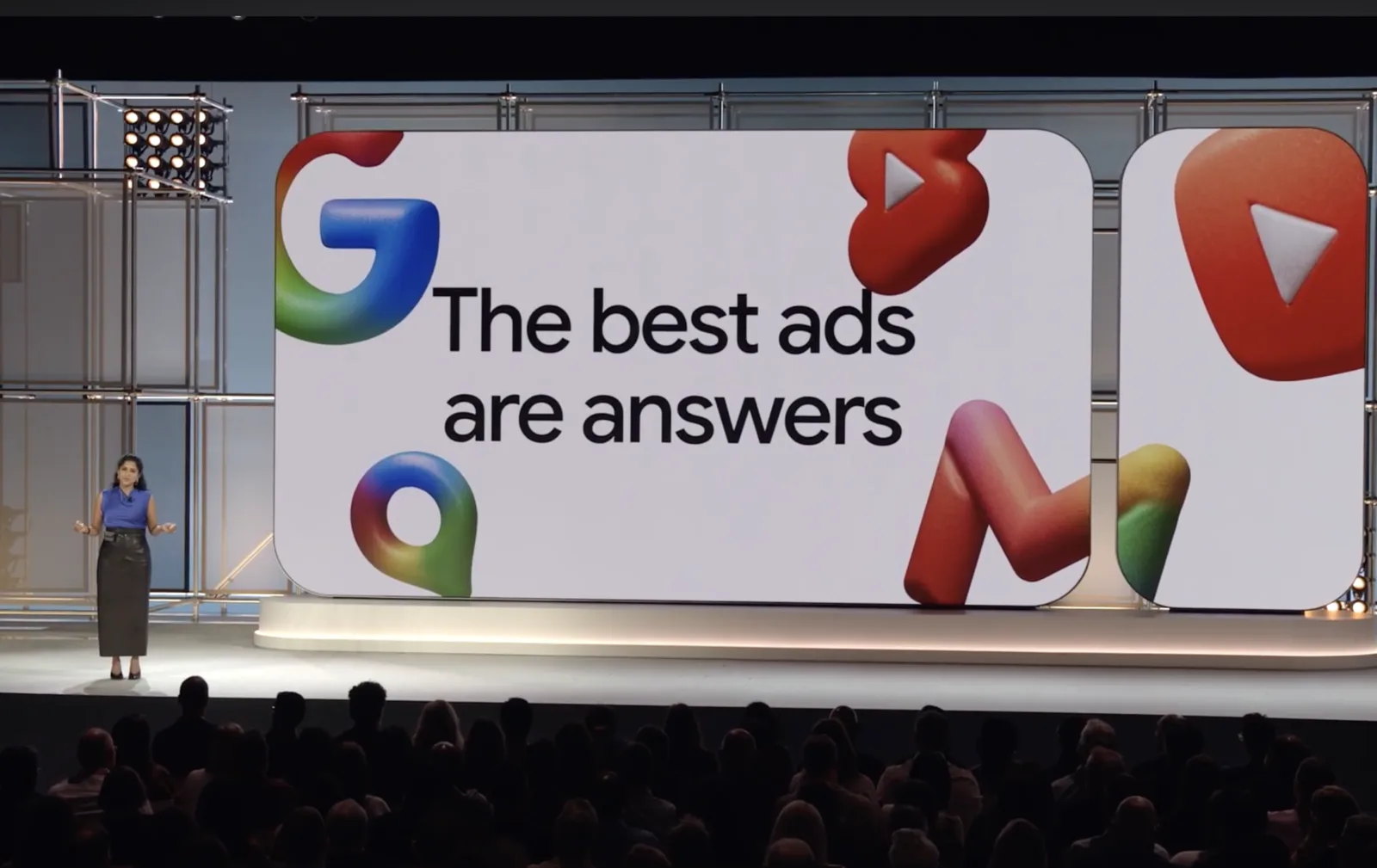
On 20 May 2026 Google held its annual Marketing Live keynote. The headline was that Search itself is being rebuilt for AI — and the advertising surface on top of it is being rebuilt at the same time. New ad formats. New control tools. New publishing requirements for any brand that wants to show up.
This is the news article in our AI Max series. Five shifts every marketer needs to act on, each with an action and a link to the deeper article that covers the how. Read this one first. Then cascade through the rest in the order at the bottom.
The brands that win the next 12 months won't be the ones running the same playbook with a new toggle. They'll be the ones who restructured their inputs — pages, conversion signals, brand briefs, URL pool, content model — to match what AI Search and AI Max actually read from.
The five shifts that matter
Strip out the keynote theatre and Google Marketing Live 2026 reduces to five shifts. Each one has a "what Google said" claim, a "what it means" interpretation, and a "what to do" action with a link to the deeper article.
Search is being rebuilt for AI
The intelligent Search box is the biggest update in over 25 years — it expands dynamically, accepts text + images + files + videos + Chrome tabs, and flows from AI Overviews into AI Mode as one experience. AI Mode passed one billion monthly users, with queries doubling each quarter.
Users are no longer typing three-word keywords. They're describing full situations. Your website now has to be readable, classifiable, and citable as a business — not just rankable as a list of pages. SEO fundamentals still hold; GEO (visibility in AI Search engines) is the new layer on top.
Ads are being rebuilt for AI too — and AI Max is the gate
Four new ad formats are coming to AI Mode: native AI Mode answer ads, Direct Offers, AI-powered Shopping ads with Gemini write-ups, and Business Agent for Leads. All of them are exclusive to AI Max or Performance Max campaigns. AI Max itself went out of beta and globally available on 15 April 2026.
AI Max isn't a Search-campaign toggle anymore — it's the entry ticket to a whole new class of ad formats. If you're on classic Search campaigns only, you can't access the formats Google is using to demo "the best ads are answers." From September 2026, Dynamic Search Ads, automatically created assets, and campaign-level broad match settings start auto-upgrading to AI Max anyway.
Your website is now part of the ad system
Text customisation generates ad copy from your landing pages. Final URL expansion picks the page Google routes users to. Business Agent for Leads draws answers inside the ad from your website. AI Max "learns from current keywords, creatives, and URLs" — in Google's own words.
The landing page is no longer just a conversion asset. It's the source AI Max reads to decide which queries you match, to generate your headlines, and to power agent answers before a human ever speaks to a prospect. A weak page doesn't just hurt CR — it hurts traffic quality, ad-copy quality, and agent accuracy simultaneously. The website is part of the targeting infrastructure now.
AI Brief lets you steer the system — if you write one
On 30 April 2026, Google introduced AI Brief — a way to give AI Max a conversational creative brief covering messaging (brand voice, claims), matching (topics to target or exclude), and audience (who to reach or avoid). It's the closest the platform has come to letting marketers brief Google's AI the way they'd brief an agency.
Most accounts will leave AI Brief blank — which is the same as telling the agency "do whatever you think." Brands that write a proper brief (brand voice descriptors, claims to favour and avoid, intent clusters to target and exclude, audience definitions) get sharper matching, copy that sounds on-brand, and AI behaviour that respects your compliance reality.
The web stack you chose for 2018 won't carry you through 2026
Implicit, not explicit — but unavoidable. Google's keynote and supporting documentation made clear that AI Max, AI Search, and the new ad formats all depend on the website being structured, fast, consistent, and machine-readable. The WordPress-plus-page-builder-plus-thirty-plugins pattern that ~42% of the web still uses was built for a different publishing model.
Your stack now has to serve three demand profiles simultaneously — SEO, GEO, and AI Max. The stacks that win serve all three from the same source content. The stacks that struggle force you to build for one and retrofit for the others, which is exactly what plugin-heavy WordPress sites do.
The numbers Google put on stage
The keynote leaned heavily on platform-scale stats. The ones worth carrying in your head:
Take all of them as directional. Your actual results depend on the inputs you give the system — your conversion signals, your AI Brief, your landing page quality, your URL pool. Google's published lift is the case for moving, not the guarantee.
Read the rest of the series in this order
This article is the news. The four pieces below are how to actually do something about it. Read them in this order:
News → mechanism → website → ad account → platform choice (if needed). Each builds on the last.
Frequently asked questions
What was the most important announcement at Google Marketing Live 2026?
Two announcements together. First, that the search box itself is being rebuilt for AI — the biggest update to it in 25 years, with AI Mode now at over a billion monthly users. Second, that a new generation of ad formats is coming to AI Mode (native AI Mode ads, Direct Offers, AI-powered Shopping ads, Business Agent for Leads) and all of them are exclusive to AI Max or Performance Max campaigns. The two together mean Search advertising is no longer a keyword game — and the brands not on AI Max can't access the new formats at all.
What is AI Max and do I need to turn it on?
AI Max is an optimisation layer Google added to Search campaigns — it uses Gemini to expand reach via broad and keywordless matching, customise headlines and descriptions from your landing pages, and route users to a different URL on your domain if Google thinks it fits better. It went out of beta in April 2026. Dynamic Search Ads, automatically created assets, and campaign-level broad match settings will start auto-upgrading to AI Max from September 2026 — so whether you turn it on yourself or wait, AI Max is becoming part of the default. The work to do is shaping the inputs Google reads from before it inherits whatever defaults you've left in place.
What is AI Brief?
AI Brief is a control feature Google launched on 30 April 2026 that lets you give AI Max a conversational creative brief instead of just keywords. Three guideline categories: messaging (brand voice, claims), matching (topics to target or exclude), and audience (who to reach or avoid). It's the closest the platform has come to letting marketers brief Google's AI the way they'd brief an agency. English-only at launch, rolling out for AI Max for Search.
What is Business Agent for Leads?
An agentic ad format announced at GML 2026 where users can chat directly inside the ad — the agent draws answers from the advertiser's website and pre-fills the lead form. Google demoed it for Education, Automotive, and Real Estate. The implication for marketers is significant: your landing page is no longer just where the click lands, it's the knowledge base an AI agent uses to answer prospects before any human is involved.
What does GML 2026 mean for SEO?
SEO fundamentals still hold — Google said this explicitly in their May 2026 AI Search documentation. Crawlable HTML, schema markup, internal linking, page speed, and editorial quality all still matter. What's added: the website now also has to satisfy GEO (visibility in AI Search engines like ChatGPT, Perplexity, AI Mode) and AI Max (paid lead generation through Google's AI-driven ads). The three demand profiles overlap heavily but each one demands something the others don't. Build a stack and content system that serves all three from the same source.
What should I do first, before September 2026?
Four things in order. First, audit your conversion tracking — AI Max optimises toward whatever signal you give it, so make sure that signal reflects real business value, not vanity events. Second, write an AI Brief that captures your brand voice, the claims you can defend, and the audiences you want and don't want. Third, classify your URL pool so Final URL expansion (if you enable it) routes to commercial pages, not outdated blog posts. Fourth, run a one-click experiment on a non-brand campaign before flipping account-wide. Without those four, the September auto-upgrade inherits whatever defaults you've left in place.
Is my current web stack ready for the AI era of Search?
Probably not, if you're on WordPress with a page builder and 30 plugins — that pattern was designed for the publishing model of 2015. The AI-era stack has to serve SEO, GEO, and AI Max simultaneously, which means consistent structured content, fast publishing velocity, machine-readable HTML, and the ability to model your business as connected entities (Offerings, Customer Types, Problems, Situations, Proof). Modern WordPress run with discipline can do it; so can Webflow/Squarespace, headless CMSes like Sanity, and AI-authored stacks like the one this site runs on. Pick what your team can actually run, not what scores best on a benchmark.